Topiaries Gone Wild

(click for larger image)

All the tops of these trees are at the same height.  If they were hedges and trimmed when they were shorter, the tops would be ragged.  Someone trimmed the tops here.  This is typical of Provence.

The Essence of Provence

(click for larger image)

The essence of Provence is orchards, vines, wines and a beautiful countryside with historic architecture.  This picture says it all.

Mock Orange Growing Near A Hedge


I was walking by a hedge in Provence, and suddenly the aroma of oranges filled the air.  I thought "Surely it is too cold to grow oranges here".  As it turns out, I was smelling a mock orange plant.  This is just another of the perfumes of Provence.

Another Beautiful Doorway of Provence


This is another in the series of doorways of Provence.  This is the doorway of a mas with shutters to keep the Mistral out.

For a book of beautiful doorways of France, follow this link:

http://www.amazon.com/dp/B00D19FLIS

Lone Flower in a Bed of Succulents


I was in the yard of a mas, looking at a typical Provencal stone sink and I saw a flowerbed with succulents.  This lone purple flower was standing out in a sea of green fingers.

Traditional Terracotta Tile Roof Details

 (click for larger image)
  (click for larger image)

The traditional roof in Provence is the terracotta tile roof.  These pictures show the detail and construction of how they are made.  Triangular rafters are laid down from the top of the roof to the sides of the house.  Then the semi-circular tiles are laid between the rafters.  The spaces are then covered with another layer of tiles turned over, and the whole thing is now a waterproof roof.

Bories of Provence

 Animal pen attached to borie

 rear view of borie

 Construction detail

 Arched door

 Borie construction over a well

 (click on any picture to enlarge image)

View looking out.

Bories dot the countryside in France.  They are unique structures built a long time ago.  Essentially they are shelters where a shepherd could seek shelter from storms as well as have a temporary place to sleep while staying with his flock.

Many bories had a bed for the shepherd and room for the animals (sheep, goats) to come into the borie.  Some had animal pens attached as well.  This particular one had a well, and a mini-borie built over the well.

They are largely unused now, or used for utility sheds, however they provide a colorful insight to the history of Provence.

The Village of Saignon

(click for larger image)

This is the beautiful hilltop village of Saignon in Provence.  These villages have a charm and an intense history that makes the past come alive.

Bent Tree at Sunset


(click for larger image)

This tree is bent from the prevailing winds and growing on the side of a hill.  The warm Provencal sunlight of the setting sun catch the leaves and turn them to luminescent orbs of light.

Palais des Papes


The Palais des Papes or Palace of the Popes in Avignon were once the replacement for Rome as the head of the Catholic Church.  Several legitimate popes lived there as well as schismatic popes.  The building is now a museum where they charge admission.  The outer facade is imposing.

Village House Door -- Les Baux-de-Provence

This is just one example of the beautiful doorways of France.  Notice particularly the security gate. It is essentially a piece of flat iron with incisions, and the incisions are peeled back to provide a decorative, yet function pattern for security.  This is a widely used pattern in Provence.

For a book on beautiful doorways of France, follow this link:

http://www.amazon.com/dp/B00D19FLIS

La Montjoie Bistro and Creperie in Aigues-Mortes

(click for larger image)

I was pleasantly surprised to find that the prices in La Montjoie Creperie in Aigues-Mortes was incredibly reasonable.  As a matter of fact, even though it is a major tourist attraction in the Camargue, the prices in all of the cafes are better than say, St. Remy-de-Provence.

Grape Vine on a Stone Wall


Grapes have been grown in Provence and wine has been made since before the time of Christ.  Viticulture was perfected in the sunny climes of France.  Here a grape vine clings to a stone wall, while young grape leaves repose in the strengthening sun.

Village Squares

(click for larger image)

I love the little squares that one finds in the villages in Provence.  They are almost like courtyards.  This particular one is in St. Remy-de-Provence.  It has a fountain, and is shaded with chestnut trees.  There are lights strung between the trees and there is a patisserie and a creperie as well as a museum and access to shops across the street.  It is a perfect place to order an espresso and watch the world go by on a beautiful day.

Chic Outdoor Table


One thing about the French, is that not only did they invent the word "chic", they embody it and embrace it.  This chic outdoor table is very well appointed with modern Mediterranean furniture, and features that make the eating experience more enjoyable.

Banon Cheese

 (click on pics for larger image)
  (click on pics for larger image)
  (click on pics for larger image)

We were visiting a friend's farm in Alpes-de-Haute-Provence.  They live just a kilometer or two away from the mountain-top village of Banon.  As we drove into Banon there is a parking lot, and immediately to the right is a fromagerie or cheese shop.  For three euros and change, we bought one of the most delicious cheeses to ever come out of France -- Banon cheese.  It is a quaint, goat's milk cheese wrapped in chestnut leaves.

This is what Wikipedia says about Banon Cheese:

Also known as Banon à la feuille, it is an unpasteurized cheese made from goat's milk and is circular in shape, around 7 cm in diameter and 2.5 cm in height, and weighing around 100 g. This pungent uncooked, unpressed cheese consists of a fine soft white pâte that is wrapped in chestnut leaves and tied with raffia.

The Provençal specialty fromage fort du Mont Ventoux is made by placing a young banon in an earthenware jar. The cheese is then seasoned with salt and pepper, doused in vinegar and eau-de-vie and left in a cool cellar to ferment. The concoction will last for many years becoming increasingly fierce in taste.

The cheese is runny right from the start.  The chestnut leaves were leaking when we bought it.  The store clerk who was the owner of the shop (and the owner of the bakery), licked her fingers after packaging our cheese.  It is that good.  The cheese spreads like a fine butter, and it is an earthy, delicious treat.

The cheese is dipped in brandy.  Here is some more of the Wikipedia article:

The affinage period lasts for two weeks, following which it is dipped in eau de vie and wrapped in chestnut leaves that have been softened and sterilized by boiling in a mixture of water and vinegar. The cheese is at its best when made between spring and autumn.
Banon was awarded the Appellation d'Origine Contrôlée (AOC) label in 2003.

If you ever seen Banon cheese anywhere, wrapped in chestnut leaves, you must buy some.  It is that good!

Close-up of the wild flowers


(click for larger image)

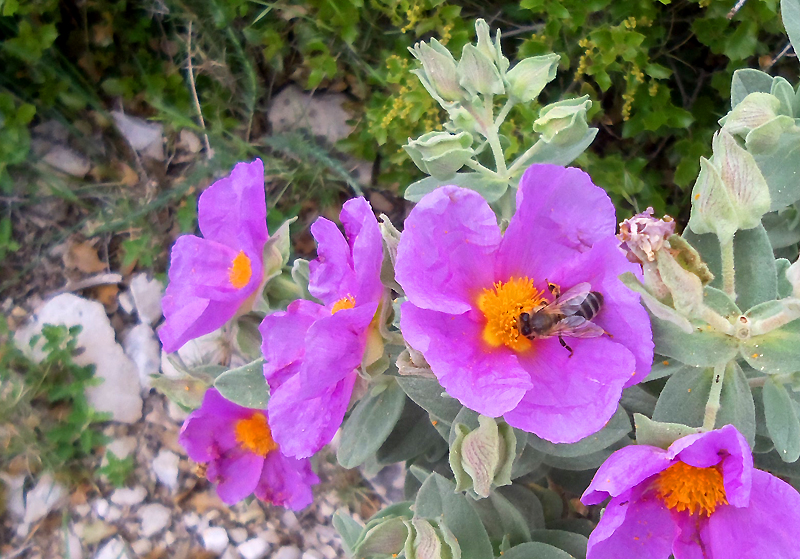
In the previous entry, I showed a wild flower bush against a peak of Les Alpilles.  Here is a closeup of those flowers.  Obviously the bees love them for the nectar.

Spring in Les Alpilles


(click for larger image to get the full effect of the picture)

Les Alpilles are the limestone mountains of southern Provence.  They are not as high as mountains go, but they have a stark beauty.  The wild flowers and herbs grow on the hills perfuming the air in the spring time.

Massive Table Bouquet

(click for larger image)

I've mentioned the ubiquity of flowers in Provencal life.  Here is proof.  Look at the massive table arrangement that I found in a bistro.  It is almost as if a giant visited among dwarfs.

A Posy of Wild Flowers in a Provencal Pasture

(click for larger image)

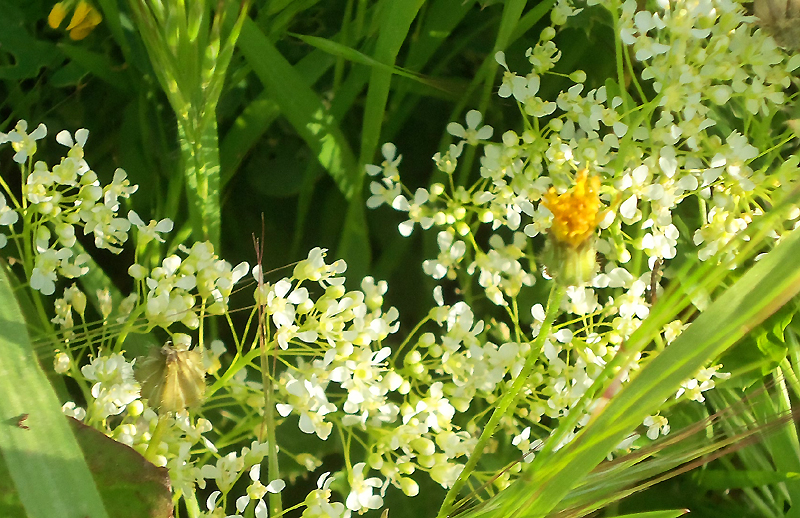
One of the nicest things about Provence, is that beautiful flowers grow everywhere, including in the wild.  These blossoms are actually weeds growing in a horse pasture that added colour to a beautiful spring evening.  The grasses, sedges and flowers freshen the air and the scents lay like a beautiful perfume over the evening air.

Vintage Eye Candy


 (click for larger images)

The past is revered in Provence.  These are pics of vintage decorations of a patisserie in a village square in Provence.  They add a rustic touch and a great ambiance to the Provence experience.  There is eye candy everywhere in Provence.

Bistros

 (click for larger images)

Bistros provide excellent eating places in Provence.  Generally you can get the pleasure of eating outdoors with a succulent meal.  This particular bistro is a highly rated eatery in St. Remy de Provence called Chez Fanny.

Boutique Hotels

(click on pics for larger image)

Boutique hotels are often the way to go when visiting Provence.  This one in Arles called Le Calendal has a spa, restaurant, cafe and free computers and Internet.  It is just steps away from the amphitheater and Colosseum built by the Romans.

Ruins of a Roman Amphitheater in Arles

(click for a larger image)

At the height of the Roman Empire, the Romans build cities, aqueducts and bridges all through Provence.  They built a huge Colosseum in Arles, and just steps away, they built this amphitheater.  This is the entrance part that archaeologists are reconstructing.  I stood on the stage in the theater part where the seats are, and I clapped my hands.  The acoustics are perfect.  The early Romans were certainly magnificent engineers.

Memorable Restaurant Meals in Provence

 L'Aile ou la Cuisse is a decent restaurant in St. Remy de Provence.  It means "Wing or Thigh" and it is named after a French movie of the same name.


 In the Camargue region, the Camargue bull is bred for fighting.  Steaks of Camargue bull are also served in restaurants.  They are delicious.


 Being so close to the Mediterranean and Moorish Africa, Arab cuisine is popular in the south of France.  The above is a tagine or traditional Moroccan stew, served at a restaurant in Arles.

 A La Chapelle de Romanin red wine is bottled as a house wine for a restaurant, complete with a custom private brand label for that eatery.


 Frites or French Fries are one of the joys of Provence.  They go well with steak, or moules (mussels) or many of the lunch dishes.


 Carpaccio (raw beef ) served with a sauce, and grated cheese over it, is an amazing delicious meal.  The beef is sliced super thin.


This salad is perfect for the warm days to be eaten in the outdoor cafes, with a nice beer or white wine.  I can't think of a more pleasant way to spend a lunch hour.